
EMS Foot Massager Not Vibrating? A Comprehensive Guide to Troubleshooting and Understanding EMS Technology

You’ve eagerly anticipated the arrival of your new EMS foot massager, envisioning deep, soothing relief after a long day. You set it up, place your feet on the EMS foot massager pad, power it on, select a program, and… nothing. No deep rumble, no satisfying vibration. Just silence. The immediate assumption is often that the device is broken. However, the most likely explanation is a fundamental misunderstanding of the technology itself. An EMS foot massager not vibrating isn’t necessarily malfunctioning; in fact, it might be working perfectly. This confusion between Electrical Muscle Stimulation (EMS) and traditional vibration-based massage is common and highlights the importance of knowing what you’ve purchased and how it’s designed to work.
This in-depth guide will explore the reasons behind the lack of vibration, differentiate between massage technologies, provide a thorough troubleshooting checklist, and discuss crucial safety considerations, especially for individuals with underlying health conditions.
Part 1: Vibration vs. Stimulation – Understanding the Core Technology
The primary reason your EMS foot massager isn’t vibrating is that it was never designed to. This confusion is at the heart of the issue. Let’s break down the different technologies:
Vibration Massage: This is the most common type of massager. It uses a small electric motor with an unbalanced weight attached to it. When the motor spins, the off-center weight creates oscillations, resulting in a shaking or vibrating sensation. This is a purely mechanical action designed to stimulate surface-level nerves and provide a general sense of relaxation.
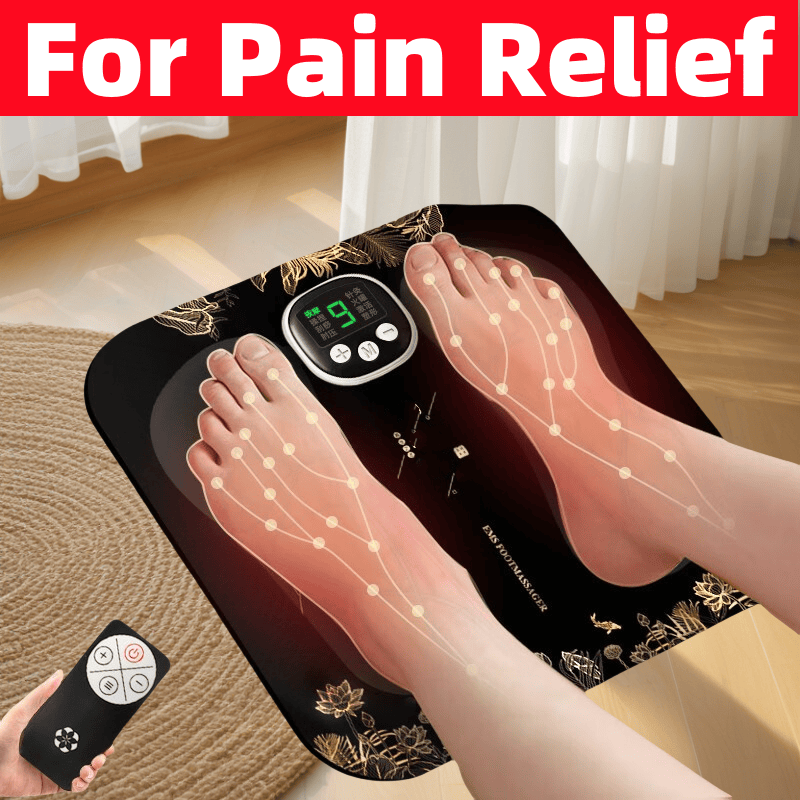
EMS (Electrical Muscle Stimulation): An EMS foot massager pad operates on a completely different principle. It uses adhesive or conductive fabric electrodes to deliver low-frequency electrical impulses directly through the skin to stimulate motor neurons. This causes your muscles to contract and relax involuntarily. The sensation is not a superficial buzz but a deeper, rhythmic pulling, tightening, or tapping feeling as your own muscles do the work. You might feel a mild tingling at the skin’s surface, but the core experience is the muscular contraction, not an external vibration.
Combination Units: Some higher-end models, including certain full-body EMS massage mat systems, may combine both technologies. They might offer vibration or heat in addition to EMS functions. It’s vital to read your product’s specifications to know which features it actually includes.
Key Takeaway: If you purchased a pure EMS device, the absence of vibration is not a defect; it’s a feature. The goal is muscle stimulation, not mechanical vibration.
Part 2: Comprehensive Troubleshooting Guide – When It’s Actually Not Working
Even after understanding the technology, you might still feel no sensation at all—no tingling, no muscle contractions. In this case, follow this detailed troubleshooting guide.
1. The Connection and Conductivity Checklist (The Most Common Issues):
EMS requires a closed electrical circuit to function. Any break in this circuit will result in no sensation.
Skin Contact and Dryness: This is the number one cause of failure. The electrical impulses cannot jump the gap caused by dry skin or calluses.
Solution: Thoroughly wipe the electrode pads on the massager with a damp cloth. More importantly, wash and dampen your feet. A small amount of water significantly enhances conductivity. For even better results, use a specialized conductive gel (often used with TENS units) on your skin where it contacts the electrodes.
Incorrect Placement: Your feet must be positioned correctly to ensure the electrodes contact specific areas of your foot (like the arch and the base). If they are misaligned, the current may not effectively reach the nerve pathways.
Solution: Refer to the user manual for exact positioning. Adjust your feet slightly and see if the sensation appears.
Clothing Barrier: Never wear socks. They are insulators and will completely block the electrical signal.
Loose Wires or Connections: Inspect the unit for any detachable wires (e.g., from a control unit to the EMS foot massager pad). Ensure they are fully plugged in and secure.
2. The Device Operation Checklist:
Intensity Level: You may have started a program at its lowest intensity setting, which can be imperceptible.
Solution: Gradually increase the intensity level using the controls. Do this slowly to avoid a sudden strong contraction.
Program Selection: Some programs are designed for warm-up or cool-down and use very mild, low-frequency impulses. Others are for active stimulation.
Solution: Cycle through the different program modes to see if others produce a sensation.
Power Source: The device may not be receiving enough power.
Solution: If it’s rechargeable, ensure it’s fully charged. If it uses batteries, try replacing them with new ones. If it’s a plug-in model, check that the outlet is working and the power adapter is firmly connected.
3. Testing and Verification:
Test on Another Person: This is the most effective way to isolate the problem. Have a friend or family member (with no contraindications for EMS use) try the massager. If they feel a distinct muscle contraction, the device is functional, and the issue is likely related to your individual physiology or sensitivity. If they also feel nothing, the unit is likely faulty.
Part 3: Physiological Factors and Serious Safety Considerations
If the device works for others but not for you, it’s critical to consider physiological reasons. This is not a reason to increase the intensity but to stop and reflect.
Individual Sensitivity Threshold: People have vastly different sensitivities to electrical stimulation. Your personal threshold for perceiving the impulses may be naturally higher.
Peripheral Neuropathy – A Critical Warning: The most serious possibility is reduced sensation due to peripheral neuropathy. This is a condition where nerves are damaged, leading to numbness, often in the feet. A common cause is diabetes. If you cannot feel the EMS impulses, it could be an early sign of nerve damage. Using an EMS device in this state is extremely dangerous. Without pain feedback, you could turn the intensity too high and cause muscle strain, skin irritation, or even burns without realizing it. This is a cardinal rule: Never use an EMS massager if you have or suspect you have peripheral neuropathy without explicit permission from your doctor.
Part 4: What to Do If the Device is Actually Faulty
If, after all troubleshooting and testing on others, the unit remains unresponsive, you likely have a defective product.
Contact Customer Support: Reach out to the manufacturer’s support team. They can provide model-specific advice and may determine a fault.
Check Warranty: Most devices come with a limited warranty. If the unit is dead on arrival or fails within the warranty period, you are entitled to a repair or replacement.
Return Policy: If recently purchased, you may be able to return it to the retailer for an exchange or refund.
Conclusion: Sensation Over Vibration
EMS Foot Massager Pad Price, Muscle Stimulator Mat
The experience of an EMS foot massager not vibrating is a classic case of mismatched expectations. The quiet, non-vibrating operation is a hallmark of pure EMS technology, which trades mechanical shaking for targeted electro-induced muscle contractions. Before concluding it’s broken, ensure you have perfect conductivity with damp skin and have correctly adjusted the settings.
However, this experience also serves as a potential health check. A complete lack of sensation, when the device is confirmed to be working, is a signal from your body that should not be ignored. It underscores the paramount importance of consulting a healthcare professional before using such devices, especially for individuals with conditions like diabetes, circulatory issues, or any form of neuropathy.
Ultimately, understanding your device’s technology ensures not only that you use it correctly to gain its benefits but also that you prioritize your safety above all else. The goal is not to feel a machine’s vibration, but to feel your own well-being improve.
Related topics:
Beyond the Bonus: Cultivating Culture with Thoughtful Corporate Gifts for Employees
https://timebusinessnews.com/beyond-the-paycheck-unpacking-the-anatomy-of-a-truly-meaningful-employee-reward/
How to Personalize Your Tungsten Ring: Inlays, Finishes, and Designs